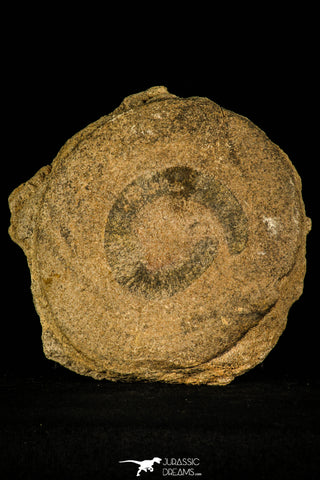
The Ouled Abdoun Basin (or Khouribga Basin), located in the central sector of Morocco, is an enormous sedimentarian basin represented mostly by a vast filling of phosphate sediments. Apart from having a relevant raw material to be extracted, it has a series of very important paleontological sites in which amazing assemblages from big and small marine vertebrates are present. The basin has a so great continuity in its stratigraphic record that both the Upper Cretaceous as well as the two first epochs of the Paleogene (Paleocene and Eocene) can be studied.
The main assemblage of vertebrate fossils of the Paleogene sector present there is composed by sharks, fish, turtles, marine snakes, rays, crocodiles, other types of reptiles and even birds. In the Cretaceous part we can add Mosasaurs, Pterosaurs and Plesiosaurs, including some rare Theropod Dinosaurs as a new Abelisaurid (Chenanisaurus barbaricus), as well as one Hadrosaurid (Ajnabia odysseus). Also present in the Cretaceous a huge diversity of sharks and fishes.
Next you can visit a link with very interesting information about this sedimentarian basin rich in fossil vertebrates: Ouled Abdoun Basin
Thalassotitan atrox n gen. n.sp
SYSTEMATIC PALEONTOLOGY
Order SQUAMATA Oppell, 1811
Family MOSASAURIDAE Gervais, 1853
Subfamily MOSASAURINAE Williston, 1897
Genus PROGNATHODON Dollo, 1889
Diagnosis from the publication : Thalassotitan atrox, a giant predatory mosasaurid (Squamata) from the upper Maastrichtian phosphates of Morocco
Sources: The Fossil Forum - Moroccan Mosasaurs - General Fossil Discussion
Diagnosis: Large mosasaurid, Premaxilla tip short and blunt. Interlocking contacts between premaxilla and maxilla. Maxilla deep, ventral
margin convex. Interdigitating joint between maxilla and prefrontal formed by a series of tongue-and-groove joints, with margins of the joint interdigitating. Prefrontal broadly overlaps onto frontal. Prefrontal-postorbitofrontal excluding frontal from orbital margin. Frontal short, broad, strongly constricted anteriorly and strongly concave at contact with parietal anterolateral wings; postorbital processes displaced anteriorly; large posteromedial processes wrapping around parietal foramen. Jugal broad and robust where its contacts the maxilla. Quadrate massive with large, fused supra- and infrastapedial processes below median part of the shaft. Tooth crowns with anastomosed ornamentation of apex and serrated anterior and posterior carinae.
Its the most common specie in moroccan phosphates.
Interesting internet links about this mosasaur species:
https://www.sciencedirect.com/science/article/abs/pii/S0195667122001793
https://nmgs.nmt.edu/publications/guidebooks/downloads/56/56_p0389_p0393.pdf
http://www.academia.edu/388824/A_new_species_of_Prognathodon_Squamata_Mosasauridae_from_the_Maastrichtian_of_Angola_and_the_affinities_of_the_mosasaur_genus_Liodon
http://www.tandfonline.com/doi/abs/10.1080/02724634.2011.601714#preview
http://en.wikipedia.org/wiki/Mosasaurus
https://www.app.pan.pl/article/item/app48-397.html
Publications:
Baird, Donald (1986): Halisaurus and Prognathodon, two uncommon Mosasaurs from the Upper Cretaceous of New Jersey. In: The Mosasaur, Vol. 3, S. 37–45.
Bardet et al. (2012) A skull fragment of the mosasaurid Prognathodon cf. sectorius from the Late Cretaceous of Navarre (Basque-Cantabrian Region). Bull. Soc. géol. France, 2012, t. 183, no 2, pp. 117-121.
Buchy, Marie-Céline; Frey, Eberhard; Wolfgang Stinnesbeck & José Guadalupe López-Oliva (2007): Cranial anatomy of a Maastrichtian (Upper Cretaceous) mosasaur (Squamata, Mosasauridae) from north-east Mexico. In: Revista Mexicana de Ciencas Geológicas Vol. 24, N. 1, S. 89–103.
Buffetaut & Bardet (2012) The mosasaurid (Squamata) Prognathodon in the Maastrichtian (Late Cretaceous) of the Cotentin Peninsula (Normandy, northwestern France). Bull. Soc. géol. France, 2012, t. 183, no 2, pp. 111-115.
Christiansen, Per &. Niels Bonde (2002): A new species of gigantic mosasaur from the Late Cretaceous of Israel. In: Journal of Vertebrate Paleontology 22 (3), S. 629-644.
Dortangs, Rudi W.; Schulp, A.; Mulder, E.; Jagt, J. W. M.; H. Peeters & D. de Graaf (2002): A large new mosasaur from the Upper Cretaceous of the Netherlands. In: Geologie en Mijnbouw, 81(1), S. 1-8.
Grigoriev (2013) Redescription of Prognathodon lutugini (Squamata, Mosasauridae). Proceedings of the Zoological Institute RAS, Vol. 317, No. 3, 2013, рр. 246–261
Kass, Michael S. (1999): Prognathodon stadtmanni: (Mosasauridae) a new species from the Mancos Shale (Lower Campanian) of Western Colorado. In: Vertebrate Paleontology in Utah, S. 275–294.
Campanian and Maastrichtian mosasaurid reptiles from central Poland Marcin Machalski, John W.M. Jagt, Rudi W. Dortangs, Eric W.A. Mulder, and Andrzej Radwański . Acta Palaeontologica Polonica 48 (3), 2003: 397-408
Konishi, T., D. Brinkman, J. A. Massare & M. W. Caldwell (2011) New exceptional specimens of Prognathodon overtoni (Squamata, Mosasauridae) from the upper Campanian of Alberta, Canada, and the systematics and ecology of the genus. In: Journal of Vertebrate Paleontology 31(5), S. 1026-1046.
Lindgren & Schulp (2010) New material of Prognathodon (Squamata: Mosasauridae), and the mosasaur assemblage of the Maastrichtian of California, U.S.A. Journal of Vertebrate Paleontology 30(5):1632-1636.
Lingham-Soliar, Theagarten &. Dirk Nolf (1989): The mosasaur Prognathodon (Reptilia, Mosasauridae) from the Upper Cretaceous of Belgium. In: Bulletin de l'Institut Royal des Sciences Naturelles de Belgique, Sciences de la Terre 59, S. 137-190.
Lucas, Spencer G.; Ikejiri, Takehito; Maisch, Heather; Thomas Joyce & Gary L. Gianniny (2005): The mosasaur Prognathodon from the Upper Cretaceous Lewis Shale near Durango, Colorado and the distribution of Prognathodon in North America. In: 56th Field Conference Guidebook, Geology of the Chama Basin, S. 389–394.
Russell, D. A. 1967. Systematics and morphology of American mosasaurs (Reptilia, Sauria). Peabody Museum of Natural History, Yale University, Bulletin 23:1–241.
Schulp, Anne S.; Michael J. Polcyn; Octávio Mateus; Louis L. Jacobs & Maria Luísa Morais (2008): A new species of Prognathodon (Squamata, Mosasauridae) from the Maastrichtian of Angola, and the affinities of the mosasaur genus Liodon. In: Proceedings of the Second Mosasaur Meeting, S. 1–12.
Nicholas R. Longrich, Nour-Eddine Jalil, Fatima Khaldoune, Oussama Khadiri Yazami, Xabier Pereda-Suberbiola, Nathalie Bardet,
Thalassotitan atrox, a giant predatory mosasaurid (Squamata) from the upper Maastrichtian phosphates of Morocco,
Cretaceous Research,Volume 140,2022,105315,ISSN 0195-6671,