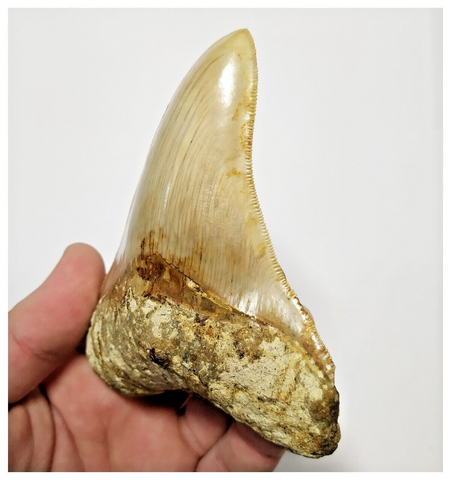
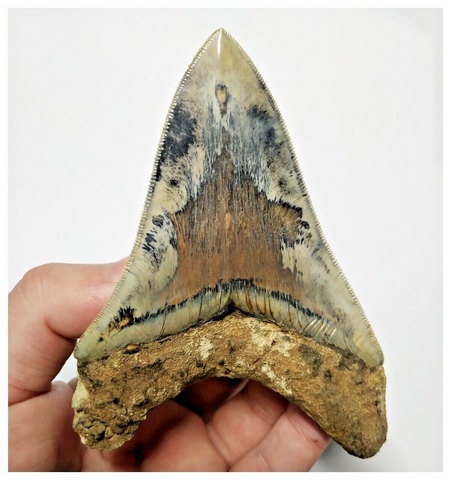
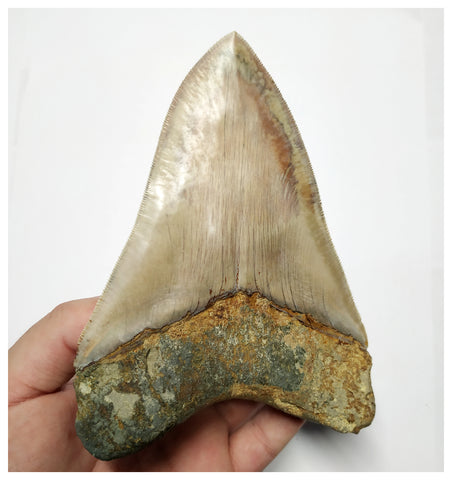
Quite rare Mosasaur species, Gavialimimus almaghribensis (the old named as Platecarpus ptychodon by Arambourg) from the Late Cretaceous phosphate deposits in Ouled Abdoun Basin from central Morocco. Perfect specimen, displaying an astonishing pristine enamel with the characteristic longitudinal ridges of this mosasaur species. Fully rooted with no restorations or repairs.
In the international market is very common to find Mosasaurus teeth coming from the phosphate quarries of the Upper Cretaceous in the Ouled Abdoun Basin (Morocco). This quarries have been exploited since the beginning of the past century. Many sellers that sell this fossils do not make a good precise taxonomic identification work.
In these sites there are numerous different species of Mosasaurs described in the enormous assemblage of giant marine reptiles that reigned the seas during the Cretaceous.
The main rich levels in these paleontological taxons are in the deeper stratigraphic levels of the sedimentarian filling of the Ouled Abdoun Basin. The age of these correspond to the Maastrichtian stage, 66 million years ago.
Most of the research carried out on these marine reptiles from Morocco have been performed by French researchers.
Next we list the different Mosasaur species which have been recognised in the phosphate rocks in North Africa:
-Halisaurus aramborgi (Bardet et al., 2005)
-Halisaurus walkeri (Lingham-Solier, 1998)
-Prognathodon sp (Dollo, 1889) NOW †Thalassotitan atrox
Longrich et al., 2022
-Prognathodon anceps (Leiodon anceps) - NOW †Thalassotitan atrox
Longrich et al., 2022
-Prognathodon solvay (Dollo, 1889)
-Prognathodon currii (Christiansen & Bonde, 2002)
-Eremiasaurus heterodontus (LeBlanc et al., 2012)
-Mosasaurus beaugei (Arambourg, 1952)
-Mosasaurus hoffmanni (Mantell, 1829)
-Tylosaurus (Marsh, 1872)
-Platecarpus ptychodon (Arambourg, 1954) - NOW Gavialimimus almaghribensis, sp. nov,2020
-Globidens phosphaticus (Bardet et al., 2005)
-Carinodens belgicus (Bardet et al., 2005)
The Ouled Abdoun Basin (or Khouribga Basin), located in the central sector of Morocco, is an enormous sedimentarian basin represented mostly by a vast filling of phosphate sediments. Apart from having a relevant raw material to be extracted, it has a series of very important paleontological sites in which amazing assemblages from big and small marine vertebrates are present. The basin has a so great continuity in its stratigraphic record that both the Upper Cretaceous as well as the two first epochs of the Paleogene (Paleocene and Eocene) can be studied.
The main assemblage of vertebrate fossils of the Paleogene sector present there is composed by sharks, fish, turtles, marine snakes, rays, crocodiles, other types of reptiles and even birds. In the Cretaceous part we can add Mosasaurs, Pterosaurs and Plesiosaurs, including some rare Theropod Dinosaurs as a new Abelisaurid (Chenanisaurus barbaricus), as well as one Hadrosaurid (Ajnabia odysseus). Also present in the Cretaceous a huge diversity of sharks and fishes.
Next you can visit a link with very interesting information about this sedimentarian basin rich in fossil vertebrates: Ouled Abdoun Basin
Gavialimimus almaghribensis
systematic paleontology
Reptilia Laurenti 1768
Squamata Oppel 1811
Mosasauridae Gervais 1852
Plioplatecarpinae Russell 1967
Platecarpus Cope 1869
Platecarpus ptychodon Arambourg , 1952
Gavialimimus almaghribensis, sp. nov,2020
Type species.Gavialimimus almaghribensis, sp. nov.
Publications:
Catherine R. C. Strong , Michael W. Caldwell , Takuya Konishi & AlessandroPalci (2020): A new species of longirostrine plioplatecarpine mosasaur (Squamata: Mosasauridae)from the Late Cretaceous of Morocco, with a re-evaluation of the problematic taxon ‘Platecarpus’ptychodon , Journal of Systematic Palaeontology, DOI: 10.1080/14772019.2020.1818322
ARAMBOURG C. 1952. — Les vertébrés fossiles des gisements de phosphates (Maroc – Algérie – Tunisie). Notes et Mémoires du Service géologique du Maroc 92:1-372.
Diagnosis :
Diagnosis: As for the type and only species. Derivation of name: Meaning‘gharial mimic’, from the Gallicized Hindi root‘gavial’and the Greek root‘mimus’, the genus name refers to morphological con-vergence between the holotype specimen and the extantgharial (Gavialis gangeticus), primarily regarding their distinctive longirostry and interlocking teeth.
Small teeth with bicarinate higly laterally compressed crowns, subequal lingal and labial surfaces bearing verticals striations that are more numerous on the lingual face and developed only on the two thirds of the crown height.
12 or 13 teeth on a dentary, 14 on a maxillary.