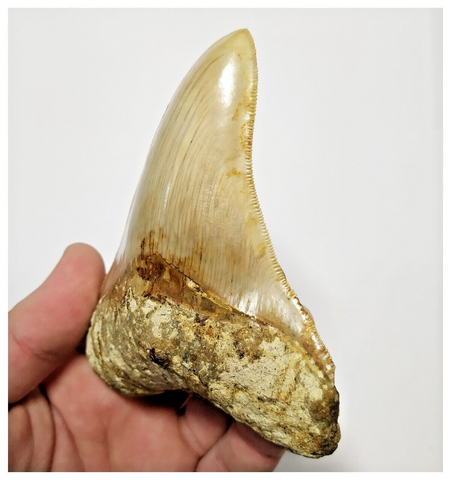
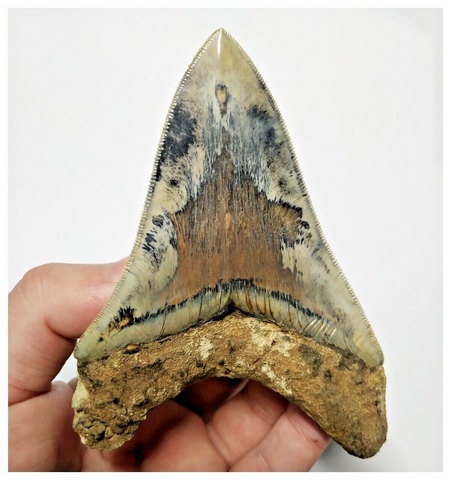
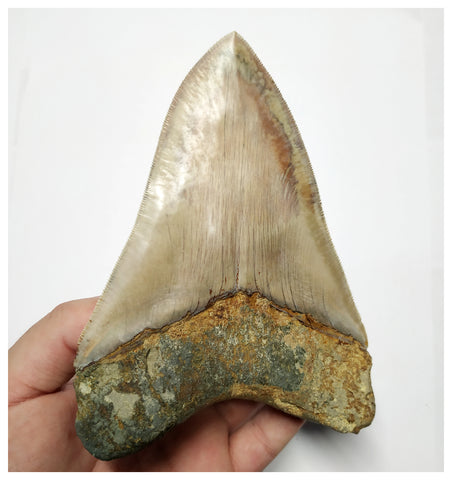
This enormous Prognathodon cf solvayi tooth is preserved in exceptional way. The size corresponds without doubt to an adult individual. The quality of the enamel is very high due to the beautiful range of caramel brilliant hues. It does not have any product or treatment that has altered its original shine and color. Top rare mosasaur species, characteristic by their several longitudinal ridges along the crown of the teeth.
This tooth is fully rooted. However, when was unearthed, the crown broke and separated from the root. Therefore, this specimen was subsequently restored by gluing and filling the tooth and reattaching the crown to the root. Apart from that, there is just a clean glued fracture in the crown.
Another very interesting aspect of this specimen is that a germ-emerging replacement tooth is visible within the root. Mosasaurs, like sharks or terrestrial dinosaurs, continuously replace their teeth throughout their lives. When a tooth begins to wear down, a new one starts to grow underneath and replaces it. Here is a magnificent example.
In the international market is very common to find Mosasaurus fossils coming from the huge phosphate quarries of the Late Cretaceous from Ouled Abdoun Basin (Morocco).
This quarries have been exploited since the beginning of the past century. Many sellers that sell this fossils do not make a good precise taxonomic identification work.
In these sites there are numerous different species of Mosasaurus described in the enormous assemblage of giant marine reptiles that reigned the seas during the Cretaceous.
The main rich levels in these paleontological taxons are in the deeper stratigraphic levels of the sedimentarian filling of the Ouled Abdoun Basin. The age of these correspond to the Maastrichtian stage, 66 million years ago.
Most of the research carried out on these marine reptiles from Morocco have been performed by French researchers.
Next we list the different Mosasaur species which have been recognised in the phosphate rocks in North Africa:
-Halisaurus aramborgi (Bardet et al., 2005)
-Halisaurus walkeri (Lingham-Solier, 1998)
-Prognathodon sp (Dollo, 1889) NOW †Thalassotitan atrox
Longrich et al., 2022
-Prognathodon anceps (Leiodon anceps) - NOW †Thalassotitan atrox
Longrich et al., 2022
-Prognathodon solvay (Dollo, 1889)
-Prognathodon currii (Christiansen & Bonde, 2002)
-Eremiasaurus heterodontus (LeBlanc et al., 2012)
-Mosasaurus beaugei (Arambourg, 1952)
-Mosasaurus hoffmanni (Mantell, 1829)
-Tylosaurus (Marsh, 1872)
-Platecarpus ptychodon (Arambourg, 1954) - NOW Gavialimimus almaghribensis, sp. nov,2020
-Globidens phosphaticus (Bardet et al., 2005)
-Carinodens belgicus (Bardet et al., 2005)
The Ouled Abdoun Basin (or Khouribga Basin), located in the central sector of Morocco, is an enormous sedimentarian basin represented mostly by a vast filling of phosphate sediments. Apart from having a relevant raw material to be extracted, it has a series of very important paleontological sites in which amazing assemblages from big and small marine vertebrates are present. The basin has a so great continuity in its stratigraphic record that both the Upper Cretaceous as well as the two first epochs of the Paleogene (Paleocene and Eocene) can be studied.
The main assemblage of vertebrate fossils of the Paleogene sector present there is composed by sharks, fish, turtles, marine snakes, rays, crocodiles, other types of reptiles and even birds. In the Cretaceous part we can add Mosasaurs, Pterosaurs and Plesiosaurs, including some rare Theropod Dinosaurs as a new Abelisaurid (Chenanisaurus barbaricus), as well as one Hadrosaurid (Ajnabia odysseus). Also present in the Cretaceous a huge diversity of sharks and fishes.
Next you can visit a link with very interesting information about this sedimentarian basin rich in fossil vertebrates: Ouled Abdoun Basin